CFD Project
CFD Analysis of Nissan S30 (Datsun 240Z/260Z/280Z)
A detalied description of the project
Background
While the Nissan S30 family of cars are known for their stunning looks, their aerodynamic performance is mediocre, to put it lightly. Especially the early cars were known for the large amounts of lift at speed, and with of drag coefficient of around 0.47, there is room for improvement.
A while back I stumbled upon the wind-tunnel tests conducted by some S30 owners from the HybridZ community (https://forums.hybridz.org/topic/55944-windtunnel-test-data/). Looking through the results, one of the scenarios peaked my interest: The data showed that somehow adding a rear ducktail spoiler, like so many owners do, actually seemed to lower the drag of the car (from ~1428N to ~1370N), while reducing rear lift by almost 800N ! .
As any curious engineer, I wanted to figure out why this was, and since I could not find any good explanations, I went online and found a 3D model of the car.

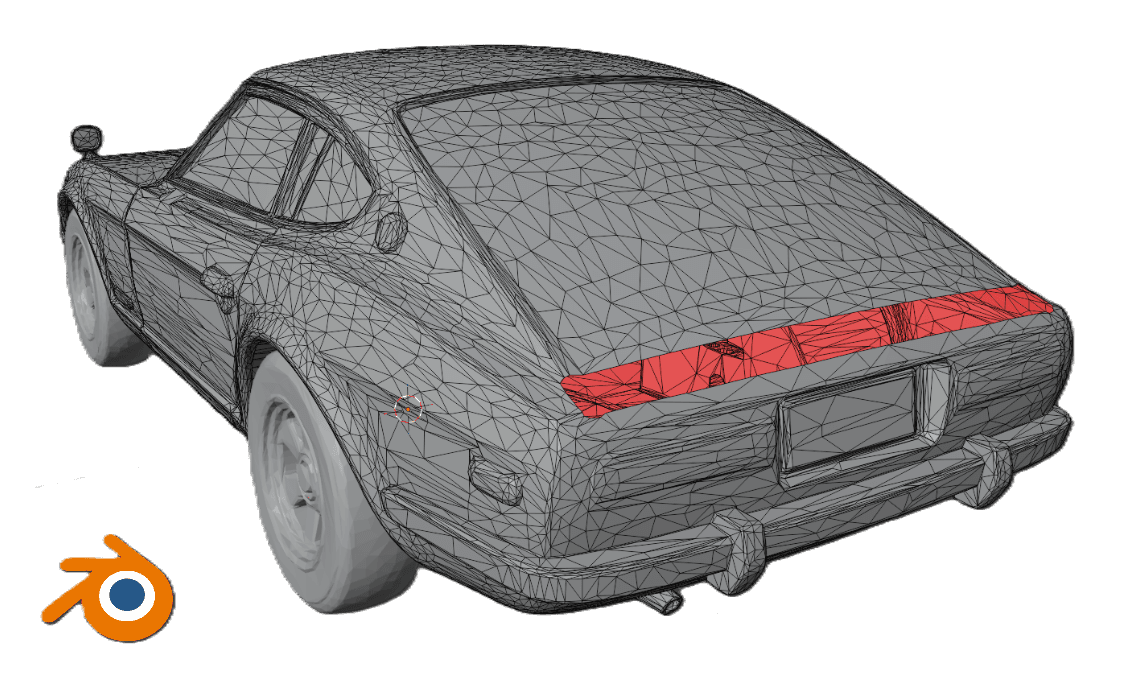
Unfortunately, the model was not exactly perfect, so I had to tweak it to make it work for my simulations. I imported the file into Blender and angled and resized the spoiler as close to the reference as possible. I also made a version without a spoiler by cutting the model and stitching it together as best I could. With the limited time I had for this project, this was good enough. Things that I was unable to fix included the closed off front of the model, which will have great influence in the front lift values, as will be seen from the results further down.
Simulation Setup and Results
Having prepared my two models, I imported them into Star-CCM+ and began setting up the simulation environment. The simulations were done with a windspeed of 120 mph (53.65 m/s) to replicate the wind-tunnel tests, with a stationary floor and non-turning wheels. The domain was modeled to be 3L upstream, 5L downstream, 3H above and 2W per side (L, H, W = Car Length, Height, Width) as is recommended for automotive simulations. The simulation was solved using k_omega with a trimmed mesher and polyhedral mesh, with 10 prism layers and refined mesh at car surface and in the wake.
The model was then checked for convergence, which was good for drag values, but somewhat oscillating for lift. This is likely due to the very unsteady behavior especially of the wake flow. I did unfortunately not have time to do an unsteady simulation yet, but the values still offer a good indication of what is going on.
As can be seen from the accumulated drag forces for the two cases on the graphs below, there is not a big difference for the drag values, although the simulation shows about 100N less, primarily resulting from lower values at the rear quarter of the car (from the c-pillar and back). This of course makes sense as this is where the change was made. The values also track somewhat with what was found in the wind tunnel tests.

More clearly, however is how big a difference the wing makes on the lift. As is seen from the below graphs (Note that the vertical axis should be read as Lift [N]), the simulations show that the wing significantly lowers lift on the rear. Without the spoiler, the lift actually increases over the tailgate, indicating either a low pressure region on the roof, or a high pressure region under the car.

The reason can be seen by looking at a plot illustrating the total pressure coefficient Cp, here shown for a plane along the center of the car. Cp = 1 indicates the surrounding (free stream) pressure, while values equal to or below zero indicate strong wake and/or flow separation. It is seen that adding the spoiler actually creates a somewhat larger wake behind the car. This is interesting when we remember that the spoiler also lowers the drag. As will be discussed in a moment, this is however to be expected for the S30 family due to what is known as the fastback problem.
It is also seen from the Cp plot that a low pressure region appears under the rear of the car when adding the spoiler. This will also be contributing to the lower lift.

A similar result can be seen when looking at the velocity profile, again shown for the center of the car. It is here more evident how the wake on the car with no spoiler tries to stay attached to the rear of the car, spiraling inwards and creating a chaotic region around the exhaust.
With the spoiler added, the wake looks much smoother, although larger, as separation is delayed. This does not, however, explain the reason for the lowered drag forces.

To explain the changes in drag, we must look at the behavior of the vortices, i.e. spinning air at the rear of the car. The below plots show the magnitude of the air vorticity (how intensely the air is spinning at a given point). Here, the more chaotic flow of the car without spoiler is once again evident. From the bottom image it is especially apparent that the air spills over the sides of the car, creating large vortices and very chaotic flow.
This is a known phenomenon described as the "fastback problem", where the sloping rear of the car causes the air to speed up over the hatch, creating a large low-pressure region generating lift. The large vortices spilling over the sides take large amounts of energy to create, thus increasing the drag of the car.
With the spoiler added, however, the air is forced to separate violently, instead of trying to stay attached behind the car, creating a much cleaner wake, and reducing some of the vortex generation, thus lowering drag.


In conclusion, adding a rear ducktail to your S30 is a great idea, improving both lift and drag, and now you know why!
This project was done as part of my studies at the Technical University of Denmark, and was as such limited timewise. Do note that the results are not fully applicable to real world behavior, primarily due to the simplified 3D model used, along with the simplified assumptions of a stationary floor and wheels. The results are however still indicative of the aerodynamic phenomena produced by the rear wing.
In the future I might create an improved model if I get access to a better 3D file, along with an unsteady simulation showing the airflow over time.
Thank you for reading :).
